Aramo Álvarez (PhD) is a creator-researcher working at the intersection of Practice as Research in postmodern dance and somatic practices, Science and Technology Studies, and fiction writing. They study bioelectrical transmaterialities, speculative anatomies, and critical utopias of somatic communication through contact improvisation and long-form fiction. Using experiential methodologies and creating Fictional Theories, they practice movement, touch, and writing as languages that open bodies to many worlds.
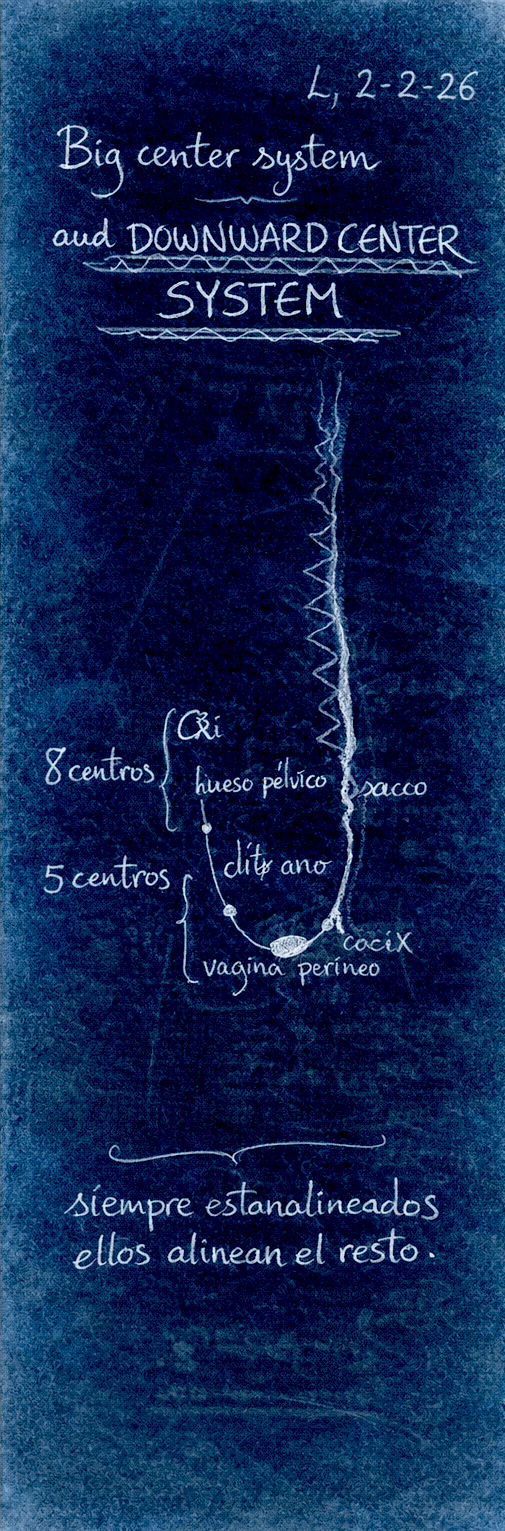
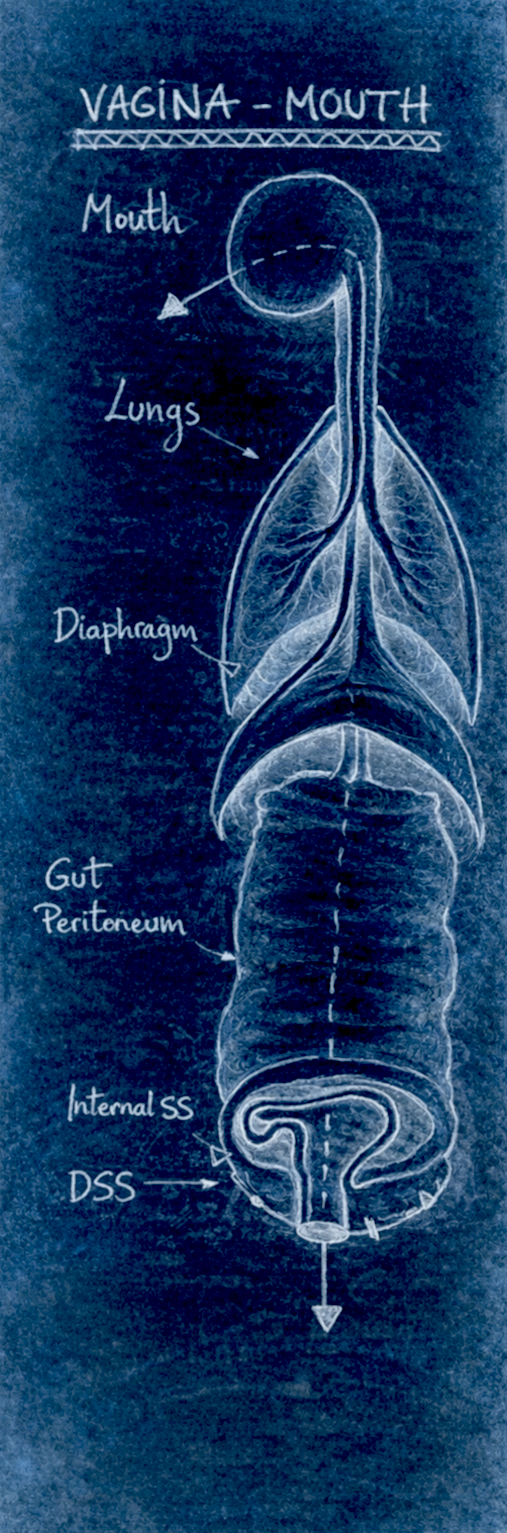
Movetouch is a somatic framework that connects holes, tubes, and different tissues through the ideas of bridge and hiatus as energetic channels. It focuses on the Downward Sexual System as a point of view of the whole body, distinguishing eight sexual centers, each relating different systems to one another. Movetouch understands the body’s relationality as non-functional and non-intentional, exploring the energies emerging from this system as more than sexual, and as holding political and somatic potential
I’m a writer of long form speculative fiction with a focus on queer worlds and transformative sexualities. My worlds tend toward critical utopias, my characters are obsessed with their bodies, and my writing is deeply enmeshed with my somatic practice. I write in both English and Spanish and am currently looking for an agent. Contact me at olaya.aramo@gmail.com
A session of loud rhythms was beginning, which was expected to last well into the morning. Many people from the region greeted them enthusiastically. "Xurde, you're at the party!" "Xurde, we have to go to Rueda to see those long, black braids!" "Xurde, how you've grown!" "Xurde, have some of this!" "Xurde, we'll be waiting for you at our house whenever you want!" Despite all their efforts to hide over the last few years, it seemed as if the whole region was waiting for them. Fortunately, there were also many people from other parts of the region and the planet who did not know them.
For Xurde, this way of dancing to a set rhythm was a bit tiring, so they crossed the large group and saw that there were many people in the river. It was moonlit, and although the moon was already waning, the light was clear and blue, illuminating the bodies of those who were bathing and chatting. Xurde squatted on one of the rocks in the middle of the riverbed to watch the sky and listen to the sound of the water. There was a small waterfall a few dozen meters upstream, with a pool where almost everyone was. A little further downstream, where Xurde was, the river was shallow, and the sound of the water was sharp and close. They could hear the voices of people laughing and singing in the pool in the distance, diving in, splashing each other, or chatting quietly, while in the background they could still hear the boom-boom-boom of the party rhythms, with frequencies so low that they felt like internal vibrations. They recognized the prism tones on the edges of the moon and observed its mountains and valleys with exquisite clarity, as if they could land there in less than two minutes. A few small clouds began to come between the moon and their eyes, and it now looked like a spotlight behind the scenes. The clouds formed several translucent layers of different colors, reminding them of last night's dance. They began to feel extraordinarily peaceful. As they breathed deeply, they could distinguish each of their tissues. The sound of the river water was becoming clearer, the voices sounded more distant, and the rhythm of the party was settling into their pelvis. They turned around and realized that almost everyone had left. They followed them and returned to the party.
They joined the large group and jumped and danced with the rest. It must have been the first time in their life that they felt part of a group. Everyone was exchanging smiles, glasses, and kisses, chanting repetitive phrases, or shouting things in each other's ears. After all, dancing was something they knew how to do. It really seemed that those who knew them were glad they were there, and those who didn't were also watching them with great interest. The rhythm began to quicken and it started to drizzle. There were screams and chants on repeat, everyone was jumping and raising their arms, and so was Xurde. Then, they saw someone a few meters ahead who, from behind, could have been Erendi, although it was hard to see with so many people jumping around. They slipped between the bodies to get closer and saw that they were kissing someone lovingly. It was obvious that they were comfortable with each other. The other person was taller than Erendi, with skin so dark that it was difficult to make out their features in the night. But when they opened their eyes, they immediately realized that it was the person who had caught their attention at the regional assembly. They froze, not knowing whether to go over and say hello, run away, or forget about it and continue dancing. Then Erendi saw them and came jumping over to where they were.
"I'm so glad you came!”
"What? I can't hear you!"
"What? I don't understand you!"
"I'm also very happy to... see you!”
"What? I don't speak the language here, I'm sorry!" Yesterday they had spoken in the common language, as is often done between people who don't know each other. But now, with all the excitement of the party, Xurde had spontaneously spoken to them in their native language.
"Ah! Nothing, I'm just saying that I'm happy too!"
"Come, come with us," they took them by the hand and led them straight to Raku.
"You're Xurde, right? You're just as they described you. My name is Raku."
"Raku, like the ceramic technique?"
"Yes, exactly. How curious that you know it, it's a very old name."
"We love old things here!" Erendi continued to hold their hand tightly, and it was obvious that they were very happy to see them. Xurde was beside themselves, but they tried to hide it, although it was difficult with so many stimuli. The rain intensified. The ground began to get muddy. Erendi rushed to kiss them. Raku too. Their clothes got wet, the music got even louder. Everyone shouted. Xurde began to leave their body and watch the scene from above. Their consciousness was about a meter above the mass of hundreds of bodies. They could see themselves there, kissing Raku and Erendi passionately, while everyone shouted. Suddenly, a huge bolt of lightning struck a few kilometers away, turning night into day for two seconds and leaving a huge trail of sparkling stars. A deafening thunderclap erupted. Everyone screamed wildly, including Raku and Erendi, and at that moment Xurde ran away, pushing aside any bodies that stood between them and the field. They ran and ran and ran at full speed straight into the forest.
The storm intensified and Xurde ran soaked through the forest, their body enveloped in lightning and thunder.
"Bjorn! Bjorn! Bjorn! Bjorn! Bjorn!" they shouted desperately over and over again. "Where are you? Where are you?" Please Bjorn, come home!!! Come home!!! Bjooooooooooorn!!! Xurde went deeper into the forest, following the paths they had learned from Roane. They saw the bright eyes of wild cats in their dens, wondering what they were doing there. The hooting of the owl, the orchestra of crows, the ferns and tall grasses, as they lost themselves in the depths of the forest where human lights no longer reached. They heard dogs and wolves howling in the distance. On the mountainside, the forest was so dense that hardly any rain fell, although the sound of the downpour on the tops of the immense trees continued to be deafening.
"Bjorn!!! Bjorn!!! Bjorn!!! Where are you??!!! Where are you??!!! Bjorn!!! Bjorn!!!"
They leaned exhausted against a tree.
"Xurde!"
They looked up at the trunk. Bjorn was sitting on one of its enormous branches.
"Bjorn! I finally found you! You have no idea how worried I was! Not just me, but everyone in Rueda, everyone is very worried!"
"I'm sorry, I didn't mean to make you feel bad.”
"Bjorn, come down, let's go home."
"No.”
"What do you mean, no? Come on, we're going to get sick in this rain. Come down, let's go."
"I said no.”
"I told you to come down!”
"And I said no. We're fine here. We've made ourselves a little house in the tree, we eat fruit and berries, and we're fine in the forest. Just like the humans of the future you always talk about. We're fine here and we're staying here.”
"But Bjorn! What about the house, and Ariel's house?"
"Xurde, it's my decision, and I beg you not to mention this encounter in Rueda or Gaviota. When we feel the time is right, we'll let you know."
"Bjorn!" It was Ariel's voice from higher up in the tree. "Who is it? What's going on?"
"No one, I'm talking to myself!"
Xurde tried to climb the tree, but the trunk was very smooth and very wet. Bjorn disappeared, jumping between the branches, like in the illustrations in the stories about the last humans. Xurde hugged the trunk with all their strength. They kept trying to climb it for a long time. The rain grew even heavier and the trunk became a torrent of successive waves of storm water rushing down from the treetop. Xurde felt too confused and thought they might come back the next day. Besides, Bjorn had begged them to leave them alone and not say anything. They had to trust them. It was well into the early hours of the morning and Xurde kept calling Bjorn, but Bjorn did not answer again.
Xurde walked slowly, crying inconsolably in the heavy rain through the forest, down the other side of the mountain. It was still dark when they arrived silently in Rueda. Stealthily, they took off their shoes at the door and slipped into their room in the dark.
"Who's there?"
"It's me, Yanael."
"For a moment I thought it was the children."
"No, it's me."
"They told us you were at the party."
"You know I don't like those parties. I really tried, but in the end I got fed up.”
"Okay, Xurde, get some rest. See you tomorrow.”
Yanael closed the door and Xurde undressed, sat down on the corner of their bed, and covered themselves with a blanket. They remained there motionless until well into the afternoon, wondering whether they should tell Rueda what had just happened.
"I already told you that the door only opens for me."
He began to breathe heavily. He crawled across the living room floor until he was leaning against the wall behind what had once been the kitchen, under the windows overlooking the building's inner courtyard. He began to touch his body with an expression of terror. Alondra smiled and slowly followed him on his desperate journey across the room. The boy touched his face, his chest, brought both hands to his genitals, and began to scream. Alondra crouched down in front of him.
"Let me see."
" Arrête!!! " the boy shouted desperately, throwing his right arm forward to interpose it between Alondra and his body.
"Well, you almost had me convinced you were mute, and now it turns out you're French."
Alondra grabbed his arm with complete naturalness, locking both his wrists behind his back with both hands. The boy burst into tears.
"Liuben, do you know French?"
A neutral and very pleasant voice replied:
"I know a little. Not very well."
"Record all of this. Tell him not to worry, the effect will wear off in a few hours."
The voice said:
“Ne vous inquiétez pas, l'effet disparaîtra dans quelques heures.”
Upon hearing another voice, the boy, instead of calming down, became even more nervous. He began to tremble, and no longer resisted Alondra's hands, which were firmly pinned to his back and against the floor. Alondra released one of her hands and slipped it under the boy's shirt, inspecting his torso from the navel up. The boy was sobbing and gasping for breath. Alondra touched the chest, where two small breasts had emerged. Then she moved her hand to the belly button, slipped it under the pants, and felt between the legs, searching for flesh. She confirmed that there was a cleft between the boy's legs and some hair. She also touched the pelvis, which had grown several centimeters in width. She felt satisfied. She stared at her, appreciating what other changes were noticeable in her face and skin. The boy, who now had the face and body of a teenage girl, looked at the floor in horror, no longer crying. He tried to breathe through her mouth as normally as possible. When he realized that Alondra would not continue touching her, he gradually went from horror back to confusion. Alondra let go of her and stood up. She grabbed one of the high chairs from the kitchen bar and sat down, still watching her. She looked at the time on the screen.
"Another sleepless night..."
Alondra went into the closed room for a moment and came back out, holding something in her hand. She went back behind the kitchen counter, where the boy was still gasping for breath from the shock.
"I need you to take off your clothes."
"J'ai besoin de toi pour enlever tes vêtements " said Liuben.
"I'm going to stay here and watch you until the end. And we need to document this."
"Je vais rester ici à te regarder jusqu'à la fin. Et nous devons documenter cela."
The boy didn't answer and continued to breathe heavily, gasping with fear. He wet herself. Alondra moved her aside and cleaned up the urine with a mop. She knelt down and began to remove her clothes. At this point, the boy was unable to show any resistance. He had entered a kind of trance. She stripped her completely naked. Then she grabbed a clean towel, dampened it with water, and slowly began to wipe the urine from between her legs. She knelt beside her, one hand resting on her pelvis and the other on her hair, watching her for a long time. When he had calmed down enough, she grabbed her jaw with one hand and turned her face upward.
"Breathe. Breathe with me. Can you follow this finger?"
"Respirer. Respire avec moi. Pouvez-vous suivre ce doigt?"
The boy did not follow her finger, but looked into Alondra's clear brown eyes, trying to understand what was happening and why she was doing this to him. Alondra sighed. She took her pulse at her wrist.
"“I’m not doing a stomach pump. I'm going to wait."
"I think you can. He's just scared," said Liuben. "Are you sure he's French? He doesn't seem to understand me, does he?"
"You already said you don't speak it very well. He's scared. And what he said was in French, wasn't it?"
"Yes, I think so."
"What's clear is that he's come from far away."
Liuben and Alondra stared at the boy until well into the early hours of the morning. In the early hours of the day, the effects of the drug began to wear off, and little by little he returned to his original body. He had been paralyzed behind the kitchen counter for hours, hugging himself and trembling. Only when his body had completely returned to its previous state did Alondra lift him off the floor, cover him with the blanket from the bedroom, and carry him to the bed.
“Here. This one is real.”
“Prise. C'est pour de vrai,” said the voice of the house computer, Liuben.
The boy did not take the glass of water. He wrapped himself in the blanket and turned away. Alondra noticed that he felt betrayed. A kind of tingling sensation rose from the center of her stomach to the middle of her lungs. She assumed it was remorse, although it could also have been arousal.
Tajo in the Cave
A silver stream runs into the eroded cavity of the mountain rock. Inside the cave, the water flows through the winding channel and piles up upside down in the pool. Condensed water drips constantly from the entire vaulted ceiling. There is too much moisture for grass to grow. The ground is freezing cold.
The cave dwelling is located a few meters from the exit to the forest. Some of the cold but dry air from outside reaches it.
The mysterious stranger chased the dogs away because they wanted to bite me. She spends her time howling at the moon outside. You can hear them in the distance, but not so far away that they can't come running in a matter of minutes.
When dawn breaks, she leaves and leaves me berries. The day passes slowly and leisurely, listening to the rain. It rains every day. The foliage acts as a huge canopy. It barely lets any light through. It dampens the sound of the rain and separates its sound from the cave. It creates two layers: the sound of the rain in the distance gives an idea of the distant landscape and distances. It feels like the cave is under the summit of a mountain. The winds come in twists and turns, as if the mountain were among other peaks. The other layer is the soaked foliage around the cave. The streams fall on both sides of the entrance arch.
The mysterious stranger left me above the pool. About seven meters above the pool rises a promontory of giant stones. On top of these stones, a flat limestone slab that must weigh over a ton forms a small plateau. The mysterious stranger has her home here. It is the driest place in the cave, although the air that fills it is almost always misty, except on the rare sunny days. On top of the limestone is a kind of mattress that I don't know how it's made, because it's nothing like the ones in Duga. I would say it's made of several layers of pressed dog hair, because I've seen remains on the scissors she keeps high up on the ceiling, where I can't reach. At the bottom of the limestone is a hole that serves as a small latrine.
The pool must empty during the dry season because it is a river. I always fear that on days of heavy rain the cave will flood, but it never does. Now that I can start to peek out a little over the pool, I can see that the stream coming from outside forms a gentle whirlpool on the surface of the water. At night, the persistent dripping keeps me awake. The mysterious stranger has hoarse nightmares in which she howls and utters random syllables that don't seem to belong to any language. I look at the scissors, which could provide me with an escape route in the future. In reality, I only think about what she might be dreaming about. Not a night goes by without her opening my body from behind before entering her animal world of dreams. She does it until she is exhausted, but I think she just wants to warm up.
When I first woke up in the cave, I saw the mysterious stranger's enormous eyes staring into mine. There was a fire burning a few feet away, and the flames burned red in her black irises. She crushed me with her weight as she straddled my hips. Her cold hand pressed my neck against the mattress of dog hair. A symphony of thousands of drops of icy water arched the space between her body, my body, and the cave.
Her legs were cold. Her gaze was fiery. Her sex was wet, wet like the fish. I was motionless, but my limbs were also numb, limp, falling. I imagined that she had drugged me because I had no control over them. I was also seeing things. Only now, after a long time, do I have this reconstruction of the scene from that first night. I had to bring the scene back to my mind thousands of times to be able to discern what was real in it. Because I also saw mermaids bathing in the pool, with long golden and purple hair and fluorescent tails that splashed silver drops on the dark and lean body of the mysterious stranger. I saw the drops on the red ceiling of the giant cave, like large planets about to explode over my eyes. I heard the songs of the mermaids, which were like the harvest songs of the Idente traditions, but much more strident and sensual. But above all, I felt that my limbs were wineskins about to be pierced, held together only by a few knotted hairs, sliding slowly from the cave bed toward the pool. My face was a large glass, and from my mouth to my anus, a long, thin glass stem was softening and warming downwards.
At some point, I don't remember when, she turned me over and, I don't know how, penetrated me. The stem of the glass continued to heat up. The hairs that bound my limbs turned into worms, the wineskins into pieces of clay, the worms into fig pulp, the clay into moss on a stormy night. The sirens stopped singing. Drops of water from the ceiling began to fall on the back of my neck, breaking into violent waves that spilled down my neck, flooding my collarbone and licking my chest. The glass of my face tipped over onto the cot. My tongue, my eyes, my brains, overflowing anemones searching for the crystalline whirlpool of the waterhole on the precipice of slippery gelatin. I was on the edge and my arms fell like vines. Drops fell from me, breaking the mirror of the water. The echo of the voice of the drops bounced off all the walls of the cave, splashing the deepest corners of my ears. The drops that entered my ear curled up in my cochlea. I felt like I was going to fall into the pool. My organs had already arranged themselves in the direction of the fall, and the pit of my stomach squeezed my throat. The end of my vertebrae had become blurred. The glass shaft had become cylindrical seaweed, the seaweed slime, and the slime foam. Strong flashes of lightning lit up my body from my pelvis to my eyes. Just as I was about to fall, the return of a violent onslaught threw me back onto the cot. The weight of the mysterious stranger's body collapsed onto my back. I regained consciousness of my form. Although as the days, weeks, and months passed, I discovered that her body was smaller than mine, at that moment it felt as heavy as the limestone on which we lived.
Bug's family home in Sea Cliff, San Francisco, August 1998
Pachamama, Pachamama, Yachay pachamama Huayra muyuy K'uychi phuyu Yachay pachamama. Inti punchay Yachay punchay Huayra muyuy K'uychi phuyu Yachay pachamama.
Pachamama, Pachamama, Wisdom of mother earth Wind that turns Rainbow cloud Wisdom of mother earth. Day of the sun Wisdom of the day Wind that spins Rainbow cloud Wisdom of mother earth.
The great hall of the house was in almost total darkness. The heads and the vivid shades of the clothes of those who were there could be made out, and the light of the moonlit Golden Gate could be seen in the distance through an impressive large window open on the sea. A figure in long, colorful, heavy robes was descending the white stairs to the left of the window. Her shuffling footsteps pushed with them an imaginary sand on the pristine varnished cherry floor on which Aidan had sat along with the rest of the no less than fifty people who stared in awe at the scene. There was absolute silence, interrupted only by the fumes rising from the audience's pipes and cigars, fireflies flickering around the descending central figure. She extended one of her arms where she carried a golden sun that also attracted the rays of the moon, creating a luminescent silhouette.
Someone had handed out many pairs of small golden finger cymbals that the attendees began to clink. Two people lit candles around the feminine figure carrying the sun, completely covered by the infinitely colored quilt, which was all pearly with glittering beads that flickered in the candlelight. Aidan was reminded of St. Anne of the Sunset, the saintly mother of Mary who was worshipped in his parish. Letting her black hair fall over her face and looking down at the floor, the priestess raised the moonlit sun in the center of the room over her head, stretching her arms to the verge of dislocation. Above the window through which the Golden Gate was visible, the moon was hidden by the sun.
“We have waited many hundreds of years for the Golden Sun to be found. The legend said that only when it is taken back to the temple of the Sun, only then, will the people of Inca be great again!”
The music began to play. Pachamama by Yma Sumac, from the movie The Secret of the Incas, unrecognizable to Aidan. The towering woman raised her dark, huge, slitted eyes and began to sing. It was actually a lip-sync, but if asked, Aidan would have categorically denied it. There was no affectation or pantomime in her performance, only the utmost solemnity. She barely moved, yet every slightest stroke of her gestures transformed the entire room, the rhythms and intensities of the audience, who participated as an improvised orchestra. Her lips and throat contracted and relaxed, folding exactly to the tone and timbre of each of the many and varied notes, displaying a vertiginous register. The attendees added rhythms with the cymbals and by hitting the floor. Voices of ecstasy, expressions of devotion to the Goddess and the Earth.
Aidan remembered the sacrament of the Eucharist. He wondered if the great sun represented a consecrated host and if the high priestess would distribute it among her parishioners. Something similar came to pass. Small crowds of devotees formed, approaching her and handing her their open chest, where she, with the sun embraced on her bare chest, rested her forehead for a second. Aidan, too, wanted to stand in this queue, for he was very used to it. But, unfortunately, after five or six of these gestures the song began to reach the final coda. The woman covered her torso again with the mantle, hiding the sun beneath her robes, and processioned to the window with the same solemnity with which she had descended the stairs, causing the audience to ring the cymbals profusely, amid shouts of jubilation, letting the long quilt form a serpentine tail across the room which many of the parishioners helped to arrange. More candelabras began to be lit, which people were placing on the few Louis XV style commodes set against the walls, or directly on the floor. There was no music and only the moonlight and its reflection on the sea water allowed the outline of the priestess to be traced, who continued to stand by the window. No one disturbed her. A few minutes passed until the people began to chat in murmurs, after having shared a long silence together in observance of her divinity.
Aidan had become totally absorbed. As other people began to stir and raise their voices around him, he realized that everyone understood the nature of the ritual except for him. He stood up, approached the priestess by making a long walk from the opposite direction, so as not to surprise her. As he approached from the other side of the window he could see her holding her robes to her chest as she gazed blankly out to sea. As he did not want to distract her but had to speak to her, as he approached he knelt down as he usually did in church. Without looking at her, he addressed her, not with the tone he used in church, in confession, where he would never have told his parish priest of his very occasional readings in Shakespeare Garden, but with the authentic devotion of the religion he did not know.
“Can I... touch the sun?” he asked.
The priestess kept looking at the sea, the glitter under her eyebrows forming a galaxy of tiny tinkling flowers. She lowered her gaze and opened her robes with one of her hands, while with the other she continued to hold the sun above her torso, which shone brightly as it was exposed again. Aidan reached out and brushed the golden metal with his fingertips. Then, slowly, he brought his forehead closer to the sun, feeling the glint of the metal in the night enter the corners of his almond-shaped eyes, and a soft vibration mingling with the goddess's breathing. Whereupon, still on his knees and fearful, he turned, rose and left the place.
The long walk home was tortuous. He was invaded by all sorts of thoughts about the nature of the city, about himself, about his family, about his girlfriend, about the university, about the world. He wondered why he had come to that temple. How he was to interpret the experience he had had. And, even though he was aware that it was nothing more than a party for rich queer people, why it had meaning. He did not expect to find answers to these questions. In any case, it had been his decision to follow those people from Golden Gate Park, because their clothes had caught his attention, because they reminded him of the manga he liked to read, because it was summer and he only had to work. He was afraid to let his curiosity get the better of him, but sometimes, just sometimes, he couldn't help it.
Shohei Tanabe
(2028)
Prologue by the Author
Movement is often associated with action. Yet, most of the movement that happens on our planet is not a doing, but part of a larger process. Movement happens. When humans move, they mimic this. Yet, we are not large enough to move in this way, so we call it action, because that’s the scope of what is possible for us. Action is a subset or an interpretation of how movement befalls in every other dimension. The dancer is a follower of movement; she tries to imitate the spontaneous happening of movement. This is, at least, one way to understand dance. It is what I have tried to prompt in the bodies I have encountered during my career. I always sought movement.
Now I’m old and sick, and I have finally understood what I cannot do. I can’t achieve a correspondence with the nature of movement. Movement is elusive. Even when I have pretended to create the conditions for movement to emerge, my dancers and I were just deceiving ourselves. There is no way humans can avoid mimesis. We try. Dancers try to find the movement that happens beyond imitation, the movement of life that unfolds in our bodies, for example by learning how to widen inertia, how to play with gravity and let the body resolve instead of moving against physical forces, or by using language in non-descriptive ways that break logic and open up the relationship between mind and body. But even this is just mocking nature.
I am a believer that humans are not natural entities. Even if made by Earth, we are betrayers of Earth. We have betrayed Earth more than other animals before. We don’t know what the future will bring, but now we know enough about the past to understand that other species, even if they transformed the Earth radically, did not betray Earth with action. Action is a human doing, the most evil of doings.
I am a pessimist. I really wanted to write my last words on a positive note, but I have come to terms with the idea that it is not who I am. I cannot play the role of a master that has reconciled with his career, with life and with learning, and that is now capable of looking at things as if they were finally simple, mysterious, or untouchable. No. I am a pessimist, so I don’t need to compromise.
Dancers are, therefore, far from being able to touch movement. We try. Earth knows we try. But we don’t. One of the reasons is: dance is not an art without words. Words stain dance and dancers, all over. In order to teach dance I have used so many words. Now I’m making more words to leave this trace of me behind. This is also action. Action is language. Language is everywhere in the human world. There is no way we humans can escape it. It’s sad.
Accepting the mediation of language, I have always sought to enter another world. This idea gives the title to this book. As a choreographer, my goal has always been to transport my students to other worlds, even if they are still here. Other worlds are always the same world, the kingdom of intensities. There are many kinds of intensities. Some feel subtle, soft. Others feel strong and powerful. But they are all intensities. In the beginning, I thought softness was not intense. This was one of my first lessons. Softness was also a search for intensity, so I became uninterested in softness. I diverted from postmodern dance, and I decided that the teachings of the softness that comes from the traditions of somatics had a better use in acting directly toward intensities, rather than mistaking softness for true presence.
Presence is a very manned word by now, but I have not found a better one. My job has been that of activating presence. I chose, therefore, an evil doing. I gave myself away to action. This meant that I hurt many young performers along the way. This introduction also wants to be an apology. Most of my students have been young, and now I regret that. Although in Japan and Korea, and in the beginning of my career, I boasted of working with all kinds of people, when I started to have a name I did what choreographers are supposed to do. I started to torment young people. They are resilient and open, I would say to myself. But the truth is they were beautiful and submissive because they wanted to be performers, and I had created an image of authority. This was wrong.
I’ve been a choreographer without work. I am grateful to my students because it was they who, through the way they included my methods in their work, made my career. There are not so many like me, but I had a reason. I despised the audience. None of my work could be done if my performers had been thinking about how they would look to the well-off classes that populate the theaters they wanted to work at. I also had teachers and mentors who made this whim of mine possible, putting me in positions of authority inside the performance world even when I hadn’t yet come out as a choreographer in my early thirties.
It’s not totally true, though. For the sake of keeping stable sources of funding, I did have to show ten or twenty things in theaters, the kinds of theaters choreographers go to see what other choreographers are doing. I had many friends in these theaters, and they also pushed my career forward. For some reason, my work was interesting to people in academia, as well. Scholars in Europe, America, and Asia considered that my work intersected with their interests, and that also helped me a lot in getting to be known and acknowledged.
I was born in Kansai and my mother was Korean, she came to Japan to work when she was fourteen, so I know how it feels to be marginalized in the country you live in, as well as in your own country. This created in me a detachment from land. I know this is not everybody’s choice. Many do the opposite: they grow more attached to land precisely as a way to stick to Earth where humans fail. It is not possible to know why some people react in one way and others in another. It was self-strangement for me. I just knew I loved men and I wanted to see the world.
When I was a mid-career artist, by the early 2000s, I realized that I had a mission more specific than movement. I was starting to grasp the fact that touching movement was not possible, and I entered a creative crisis, which only resolved by focusing more and more on my career. At the same time, I started to feel that there was something concrete about presence, not just a generic concept, or a state of flesh. What I had called “movement” was not the action of movement — I already knew that action was a trap — but something that could happen during movement. It was difficult for my young dancers to pinpoint it. They were too energetic, too focused on action themselves. We were trapped all together in this illusion that movement for the sake of movement was a good thing.
One day, in my hometown, one of my neighbors told me that she had seen things during the workshop. She described her visions of Earth to me. I knew that was what I was seeking. My method was actually a trick, a kind of surgery, a sorcery, a hypnosis. I finally took my place among the magicians, the psychics, and other illusionists. It was about getting to know what people were seeing when I led them through these practices of disembodiment.
I call them practices of disembodiment now, because I no longer believe the human body has an aspiration higher than being what it is. Certainly, we live in a disembodied culture, but I do not believe in embodied cultures. That notion sounds to me equally exotic. Disembodiment is the way of action, others call it awareness. Lack of awareness could be closer to movement or what many in Germany and America like to call embodiment. The more we practice this faculty, the further we get in our experience of humanness, still always an unnatural way of being.
But my pessimism was rewarded. I realized that stimulating this disembodiment, this disconnection between the person and their body and mind, a space was opened in which some visions occurred. I call them visions but many of them are tactile, sound, or smell-based. I believe they are memories from the future, for time looses out when there is no body. My neighbor told me about a feminine figure, a river that went upward, a machine that crossed the ocean in minutes.
I became obsessed with this, and I started to design my trainings to put people in states that allowed them to access this place. It was different for everyone, but everybody could access it.
Most people will say that this is fantasy, an interesting place for producing images, like novelists do. I do believe those images come from Earth. And beyond. Other people would ask me why I didn’t go ask those who report that they see images directly? I was my own Frankenstein: I wanted to create my own monster. I believed myself to be better than others, more capable, that my images would be more refined, that they would make sense together like an Italian fresco.
Of course, I was wrong. After a phase in which I looked for the relation between the intensities of personal history I moved to the intensities of human history and the nature of movement. Then I switched to the intensities of flesh, and then to those of things. All of a sudden, I was already in my sixties. Generations of younger dancers and actors knew me, and they started saying I had traumatized them. They were right. I stopped teaching.
The times had changed. I have always been very aware that I belonged to a generation that was being led back to war, so I expected that my work would only be possible for a number of years, until the demands of wartime would put morals into question again, as it happened. I was very lucky to spend my youth in the seventies and eighties, before the whole world learned how to reorganize conservatism and militarism around the destruction of our Goddess Earth.
Now we are living in war again. A cross-cultural war. And my days are coming to an end. I reckon I will probably not get to see the world that can come out from this action. I am still a pessimist. However, I treasure the testimonies of my students that I have collected through decades. Some of them are gathered in this book. I know for some of my colleagues this will be the end of my professional credit, for many will think I’m just crazy. I’m honored to be called that. It means I have achieved what I did not know was my goal in the beginning: to escape the logic of those who make the wars.
About movement: many of my students told me that, when they dream that they fly, they need to push against the Earth with a lot of effort, because it drags them down. But there is a moment when the dreamer’s effort, her action, is bigger than Earth and the flight is released, like those imaginary planes of mathematics in which an object suffers no friction. It’s not by coincidence that many people who are capable of attaining states outside the shared world enjoy mathematics. I was not graced with numbers.
One day, the student to whom this book is dedicated told me about one of these flights. He was flying with a bird over a green Earth full of ruins. Many other students mentioned this bird, which you can see on the front page of this book, beautifully represented by my dear long-life disciple Li Song Yun. I believe that this bird represents the Goddess that will overtake Earth and remove it from human hands. And soon. Very soon. Very soon.
My method has tried to be a method to bring her to life, but I have failed. I know I have failed, even if some of my students have grasped her, have seen her. As I told this student of mine, that I loved, I was presumptuous. I thought I could just use bodies as filters, and at the same time remain famous and recognized, that I could make individuals suffer so they would decant the Goddess. I thought I was giving them credit in exchange. But of course things don’t work like that. You can’t exchange anything in the world of life. I was acting like a human myself, how could I touch the un-human like this? I was terribly stupid.
But there is one thing I have come to terms with. As there is no possibility of achieving my goals as a choreographer, my mistakes have led me to learn about this impossibility. Along the way, I have learnt a lot about disturbance, collision, effervescence, the relationship between language and flesh, the techniques of humanhood. In this book you will find some notes about them. Intensities have been an incredible place to live. My land.
Shohei Tanabe, Berlin, June 2028